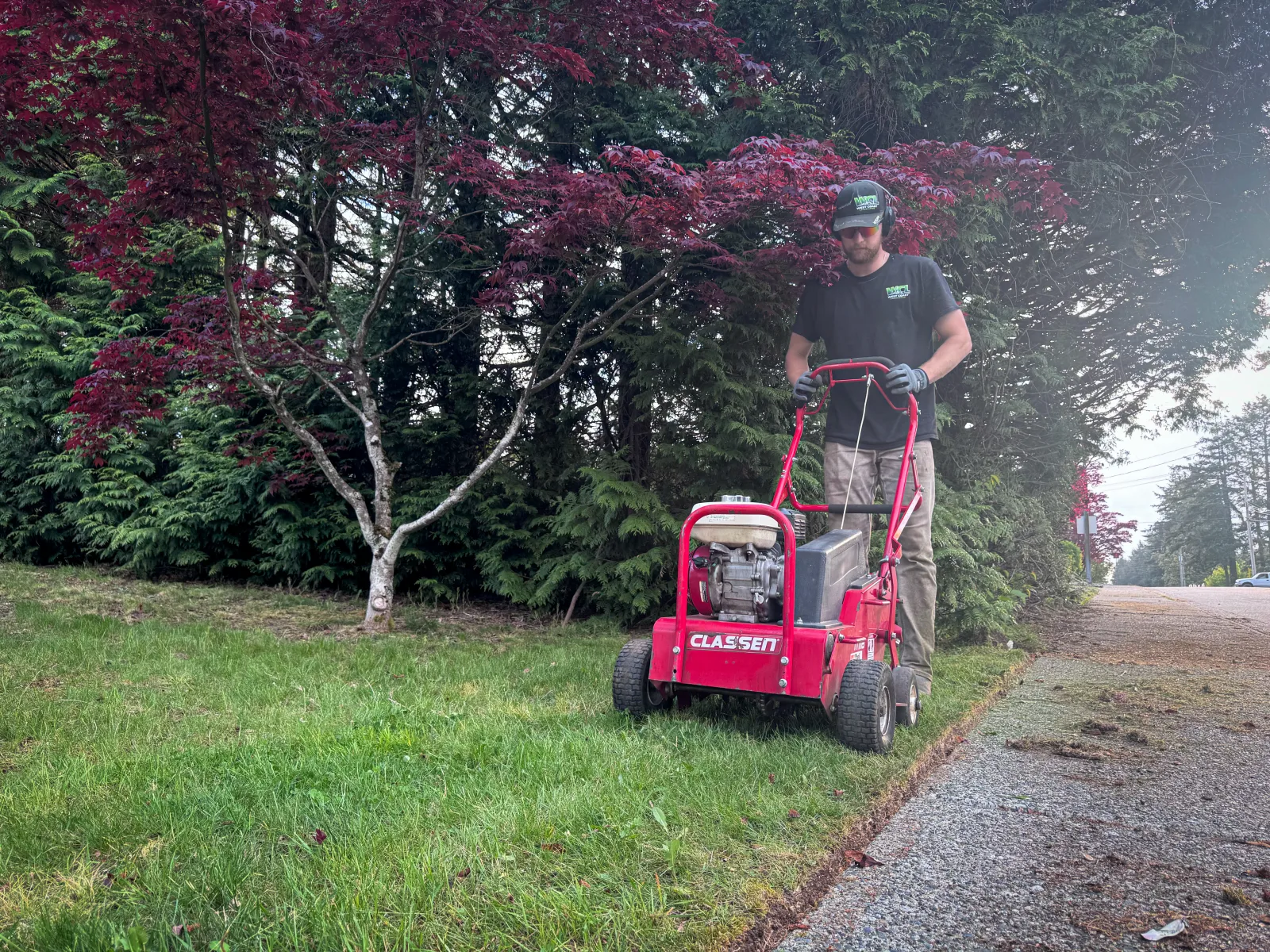
A lot of Ladysmith lawns haven't been aerated in years. Sometimes decades. The town's character of older homes on smaller lots, sometimes with absentee owners or homes that have changed hands repeatedly, means lawn care has often been minimal. The good news is that aeration and dethatching can transform these neglected lawns dramatically — the underlying soil and structure are usually fine, the lawn just needs renovation work to bring it back.
Catching up on years of needed work
The first aeration on a long-neglected Ladysmith lawn is usually a real renovation, not just maintenance. Heavy thatch removal, full aeration, generous overseeding, top-dressing with compost, granular fertilization — the whole sequence applied at full strength because the lawn really needs it. The result after a season is dramatically improved turf.
Subsequent years are easier. Once a lawn is on a regular renovation schedule, the work shifts to maintenance rather than recovery.
Sloped lots, specific challenges
Most Ladysmith lawns have at least some grade to them, which complicates aeration in a couple of ways. Walk-behind core aerators are heavy and need to be operated carefully on slopes — we work across the slope rather than up and down for stability. Watering after renovation is also harder on slopes (water runs off rather than soaking in), so timing the work for cool, moist weather windows matters more here than on flat ground.
Older lawns, different soil profiles
Ladysmith's older lawns sometimes have soil profiles that don't match what you'd find in newer subdivisions. Older fill, original site soil, decades of organic matter accumulation, and sometimes underlying rocky terrain because of the hillside character. We assess the soil before renovation and adjust the approach accordingly. Sometimes a full multi-pass aeration is the right answer; sometimes a more conservative approach works better.
For the underlying principles, see our aeration and dethatching guide.
The full sequence
- Mow short a day or two before
- Dethatch — often more aggressive on long-neglected lawns
- Aerate with multiple passes if compaction is severe
- Overseed generously into bare and thin spots
- Top-dress with compost to build the soil profile
- Apply granular fertilizer at the right rate
- Water consistently for two to three weeks
Top-dressing especially helps older Ladysmith lawns. See our lawn top dressing guide for the technique and the reasons.
Spring is usually the right window
Spring renovation works particularly well on Ladysmith's hillside lawns because the soil is still moist from winter, the cool temperatures favour seed germination, and the lawn has time to establish before summer heat arrives. Fall renovation is fine too, but the timing has to be early enough that the new growth establishes before winter (mid-September is typically the cutoff).
What we don't do
No chemical sprays — same as everywhere we work. Granular fertilization, lime, dethatching, aeration, overseeding, and top-dressing are all inside our scope. Chemical weed and moss work is handled by the homeowner or a licensed applicator separately.