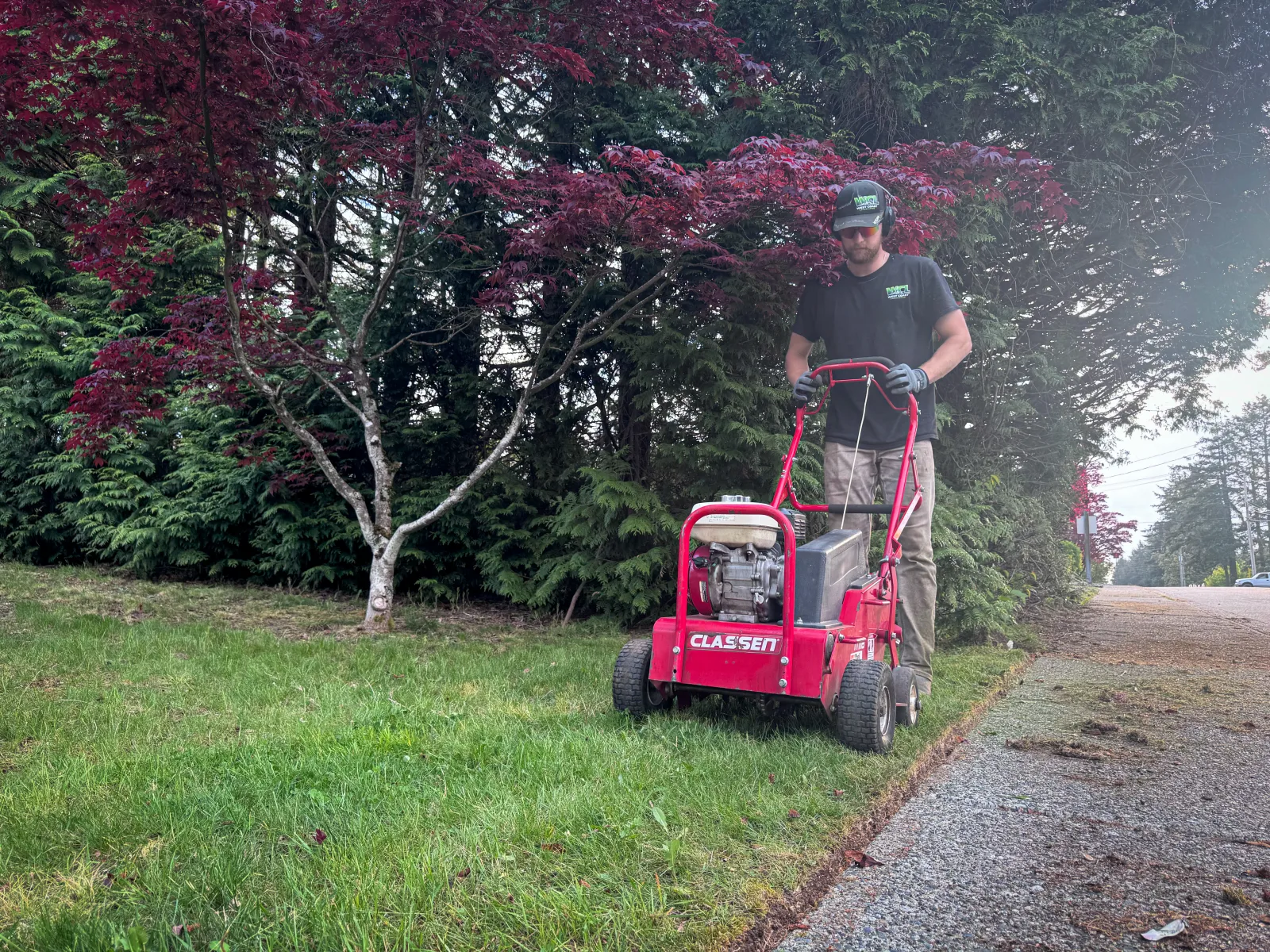
If your Nanaimo lawn looks tired, water seems to pool on the surface instead of soaking in, or moss is winning the moisture battle, the answer is almost always the same combination: aerate and dethatch. Both are about getting your lawn breathing again, and both are usually overdue.
What thatch is, and why it matters
Thatch is the layer of dead grass stems and roots that builds up between the soil and the green grass blades. A little thatch is normal and even helpful — it conserves moisture and insulates roots. Too much (more than about half an inch) becomes a problem: water can't penetrate, fertilizer sits on top instead of feeding roots, and the lawn slowly chokes itself.
Coastal BC lawns build thatch fast. The mild, wet winters keep grass roots growing year-round, and the slow decomposition rate of cool, damp soil means dead material stacks up faster than it breaks down. Most Nanaimo lawns benefit from dethatching every couple of years.
What aeration does
Aeration uses a core aerator to pull small plugs of soil out of the lawn, leaving thousands of small holes across the surface. Those holes let water, oxygen, and nutrients reach the root zone — and they relieve compaction. Compaction is a real issue on Nanaimo's heavier clay pockets, particularly in high-traffic zones (paths, play areas, places the dog patrols). Compacted soil drains poorly and starves roots; aeration is the fix.
For a deeper look at how the two services work together, see our aeration and dethatching guide.
Spring or fall — both work
The right window for aeration and dethatching in Nanaimo is either early spring (March-April, once the soil has warmed but before the heat of summer) or fall (September-October, when growth is slowing but the soil is still warm enough for recovery). We do both seasons depending on what your lawn needs and your schedule.
Avoid the peak of summer (July-August) — the lawn is already stressed by heat, and aerating then just compounds the stress. Same with deep winter, when the lawn is dormant and won't recover before the next growing season.
The full renovation sequence
Aeration and dethatching are usually paired with overseeding (filling in thin spots with new seed) and a granular fertilizer application. The order matters:
- Mow short a day or two before
- Dethatch first to remove the dead layer
- Aerate next so air, water, and seed can reach the soil
- Overseed the bare spots
- Top-dress lightly with compost (optional but excellent)
- Apply granular fertilizer appropriate for the season
- Water deeply for the next two weeks
Done in this order, the renovation transforms a struggling lawn within a single season. For more on the seeding side, see our spring lawn repair and overseeding guide. And on the moss side that often goes hand-in-hand: our moss removal guide covers the lawn-side moss work.
What we don't do
We don't apply chemical sprays — no iron sulphate, no herbicides. Granular fertilization, lime, and the physical work of aeration and dethatching are all inside our scope. The chemical-spray steps for moss kill or weed control, where they're appropriate, are the homeowner's to apply (or you can hire a licensed applicator separately). We handle everything around it.
Ready to fix the lawn? More on what we do across Nanaimo →