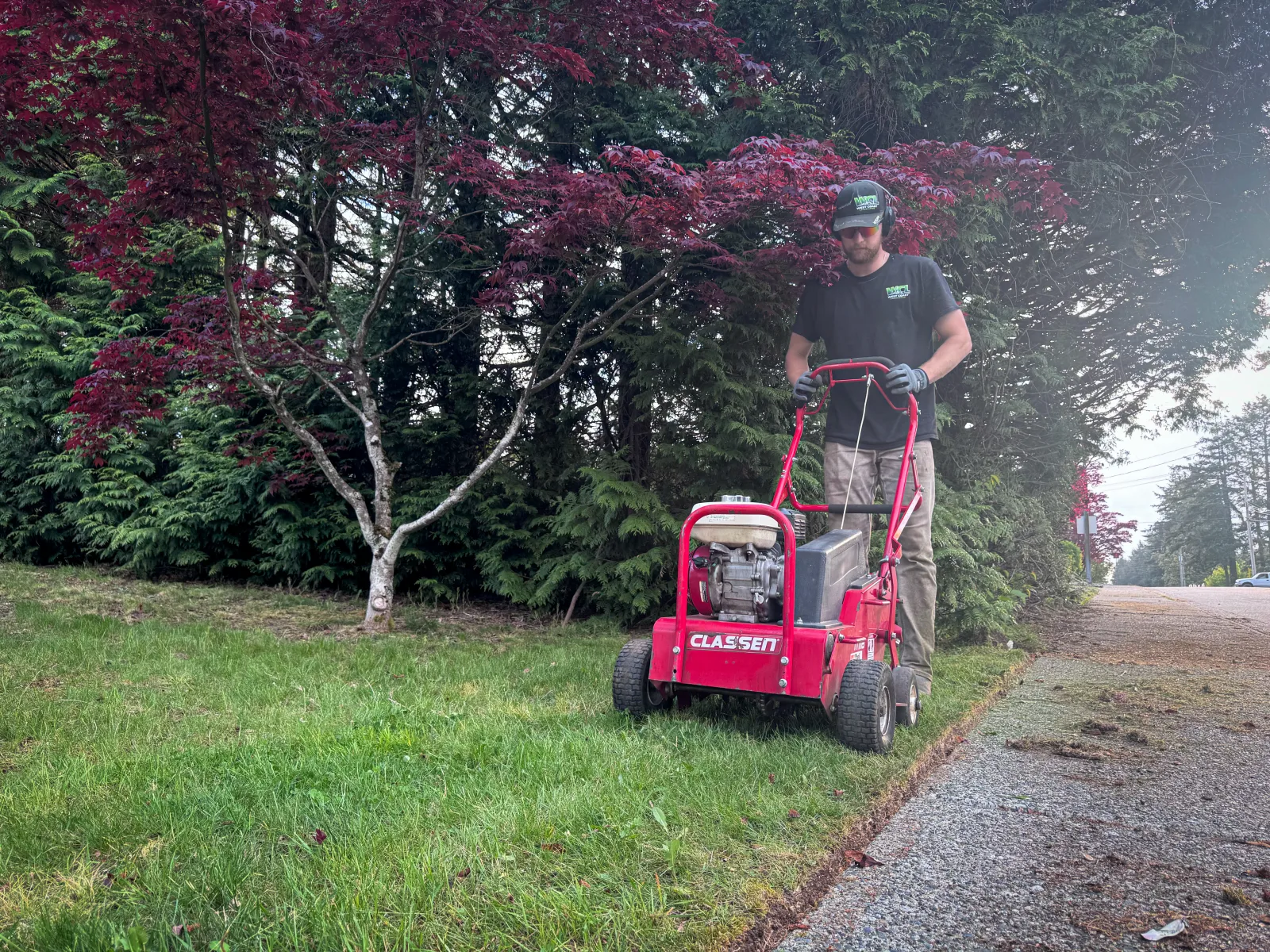
Lawn aeration is one of the most recommended services in property maintenance — and one of the most varied in terms of what you pay and what you actually get. If you're trying to figure out what professional core aeration should cost in Nanaimo, here's a straightforward guide to pricing factors, timing, and what a good quote should include.
How much does core aeration cost in Nanaimo?
Aeration is almost universally priced by lawn size — the total square footage of turf being serviced. A small city lot costs meaningfully less than a large acreage property in Lantzville or Ladysmith. Whether dethatching, overseeding, or topdressing are included in the same booking also affects the total significantly.
The most accurate figure comes from requesting a quote with your approximate turf area and any notable access constraints — most professional lawn care companies will give you a clear number quickly. What we can say plainly: core aeration is one of the lower-cost professional lawn services relative to the return it delivers. A lawn that's properly aerated recovers faster from summer dry spells, absorbs water more efficiently, and responds better to fertilization — meaning you often spend less on follow-up inputs over the course of a season.
What makes aeration more or less expensive?
Several factors move the price meaningfully:
- Lawn size — The single biggest driver. More square footage means more machine passes and more time, and pricing scales accordingly. There's often a base rate for small properties and a per-square-foot rate for larger ones.
- Access and obstacles — Can equipment reach all areas efficiently, or are there tight gates, narrow side-yards, slopes, or raised beds that require hand tools? Difficult access adds time and cost regardless of lot size.
- Lawn condition — Heavily compacted or thatched lawns sometimes require two machine passes for the aerator to penetrate effectively. A single pass is standard for well-maintained lawns; severely compacted ground may need more.
- Add-on services — Overseeding immediately after aeration delivers dramatically better germination, because the cores left by the aerator create direct seed-to-soil contact. Dethatching, lime application, or topdressing added to the same visit also increase cost — but combining services in one mobilization is usually more efficient than booking them separately.
- Season and demand — Spring is peak demand for aeration in Nanaimo. April and May schedules fill quickly, and some companies charge a premium during the busiest weeks. Booking in September typically means easier scheduling and sometimes a slightly better rate for equivalent work.
Should I aerate and dethatch at the same time?
If your lawn has a thatch layer thicker than about 1.5 cm, yes — dethatching before aeration improves the outcome noticeably. The aerator cores penetrate soil more effectively when they're not fighting through a compressed mat of dead grass roots and organic matter. Doing both in the same visit also means one mobilization, one cleanup disruption, and one bill instead of two.
If your lawn doesn't have significant thatch — common in Nanaimo properties that receive regular professional maintenance — aeration alone is usually sufficient. Over-dethatching a lawn that doesn't need it creates unnecessary stress on the grass during the recovery period.
A quick field test: push your finger through the surface of the turf and press down. If you hit firm soil within 1–1.5 cm, thatch is minimal. If there's a soft, spongy layer and it's difficult to feel the soil at all, dethatching is likely worth adding.
How often does a Nanaimo lawn need aeration?
For most Nanaimo and Lantzville lawns: once a year is the ideal maintenance frequency, in either spring or fall. Heavily compacted lawns — high-traffic zones, clay-heavy soil, or properties that went multiple years without aeration — sometimes benefit from two sessions in the first year to break the cycle, then dropping to annual maintenance after that.
Vancouver Island's coastal climate puts particular stress on soil structure over time. Our wet winters compact the surface layer progressively, and the clay content in many Nanaimo soils makes compaction worse year over year without intervention. Annual aeration breaks this cycle before it becomes expensive to reverse. A lawn that gets aerated consistently is easier and cheaper to maintain than one that requires periodic rescue treatment.
Many properties in Nanaimo and Ladysmith sit on clay-heavy soil that compacts more aggressively than sandy coastal lots. If your lawn puddles noticeably after moderate rain, or if a screwdriver tip meets hard resistance within 5 cm of the surface, compaction may be worse than you think — and possibly worth two rounds in the first year.
Is spring or fall the better time to aerate in Nanaimo?
Both windows work well, and both have genuine advantages.
Spring aeration (April–May) pairs naturally with the rest of spring lawn preparation: overseeding bare patches, fertilization, lime application. The grass is actively growing and recovers quickly — aeration holes close up within one to two weeks as the turf fills in. Spring is the most popular window in Nanaimo and Parksville, which means scheduling fills up fast. Book early if you want April or early May.
Fall aeration (September–October) means less competition for scheduling, cooler temperatures that reduce stress on the turf, and natural core breakdown as fall rain arrives. The holes close gradually through soil movement over the wet fall and winter, leaving the lawn ready for spring with improved drainage built in. If your spring was too busy or the soil was too dry to work well, fall is a perfectly valid second window — not a backup plan.
If you can only do one: spring tends to show faster visible improvement, because the lawn immediately uses the improved drainage and aeration as it enters active growth. But a well-done fall aeration is genuinely beneficial — it's not a consolation prize.
Can I rent an aerator and do it myself?
Yes — core aerators are available at equipment rental shops in Nanaimo. The practical realities are worth knowing before you commit. These machines are heavy, often 130–150 kg, and physically demanding to manoeuvre, especially on uneven ground or around obstacles. Most rentals need to be returned the same day, which means loading, operating, and unloading all happen on a single timeline.
For a small urban lot, the DIY approach can absolutely make sense. For larger properties, the combined cost of the rental, fuel, your time, and the physical effort often approaches the price of hiring a professional — and a trained operator will cover the ground more efficiently and consistently than someone running the machine for the first time.
One practical note that surprises some homeowners: the small cores of soil left on the surface after aeration are supposed to be there. Leave them. They break down naturally within one to two weeks as rain and lawn traffic work them back into the turf. Trying to rake them up defeats some of the benefit and significantly adds to the cleanup effort.
What should a professional aeration quote include?
A clear and trustworthy quote should specify:
- The total turf area being serviced
- Number of passes (one is standard; two may be recommended for severely compacted lawns)
- Whether core plugs are left in place (correct, beneficial practice) or collected (unnecessary extra work)
- Whether overseeding, topdressing, or dethatching are included or priced separately
- Any areas excluded — gravel, ornamental beds, slopes too steep for machine access
If a quote is vague or unusually low, ask specifically whether it's core aeration or spike aeration. Spike aeration uses solid tines that punch holes without removing any material — it provides minimal benefit for genuinely compacted soil and doesn't address the root cause. Core aeration, which extracts small plugs of soil from the ground, is what actually improves soil structure. If a quote doesn't specify, ask before you book.
West Coast Landscaping provides professional core aeration across Nanaimo, Lantzville, and Ladysmith. If you're not sure whether your lawn needs aeration, dethatching, or both — we'll take a look and give you an honest assessment before quoting. No upselling, just what the lawn actually needs.