Every spring, the same pattern plays out across Nanaimo. Homeowners watch patches of lawn stay thin through the wet months, try a round of fertilizer, maybe overseed, and still can't get the grass to fill in properly. The fertilizer helps a little. The seed germinates slowly and patchily. The problem comes back next year.
More often than people realize, the real culprit isn't a nutrient deficiency or a disease or even poor seed. It's the soil itself — packed so tightly that grass roots can't penetrate deeply enough to access water and nutrients even when both are present. Compacted soil is the most underdiagnosed lawn problem on Lantzville and Nanaimo properties, and it gets worse every year without targeted intervention.
Why Nanaimo Soil Compacts
Vancouver Island's clay-heavy soils — especially in older Nanaimo neighbourhoods and newer Ladysmith subdivisions where land was graded during construction — are particularly prone to compaction. Clay particles pack densely when wet, and then foot traffic, equipment, and even rainfall impact compress them further. Our wet falls and winters saturate the ground, making it especially vulnerable to compaction during the months when the lawn gets the most incidental traffic.
Even well-established lawns on good soil compact over time without active management. Every mowing pass, every backyard gathering, every heavy rain adds pressure. The question isn't whether your soil will compact — it's how much, and whether you're doing anything about it.
Step 1: Read the Warning Signs
Compacted soil announces itself if you know what to look for. Water that pools or drains slowly in spots that used to drain fine is a clear indicator — compacted soil can't absorb rainfall at a normal rate, so it sits on the surface. Grass blades that look thin and pale at the base even during spring's growing season suggest roots hitting resistance before they can establish properly. And an explosion of broadleaf weeds — dandelions and plantain in particular — is telling. These plants have long, penetrating taproots evolved specifically to punch through dense soil. Where they thrive, grass is struggling.
Plantain weed (the broad, ribbed-leaf rosette, not the banana) is a near-perfect indicator of compacted soil. If you have a lot of it, you almost certainly have a compaction problem underneath.
Step 2: Do the Screwdriver Test
This takes thirty seconds and gives you a clear picture. Push a standard flat-head screwdriver straight down into your lawn using only hand pressure — no hammer, no stomping. In healthy, well-aerated soil, the blade should sink to the handle with little effort. If it stops after 2 to 3 cm, or you can't push it in at all, the compaction is significant enough to be limiting your lawn's health.
Walk the whole property and test several spots. Compaction is rarely uniform. The worst areas are typically high-traffic paths from the door to the garage, zones near driveways or hardscaping, and areas under large trees where roots have been compressing the soil for years. Knowing the worst areas helps you prioritize and gives you something to compare after treatment.
Step 3: Check Your Thatch Layer
Compaction and thatch form a feedback loop that many homeowners don't realize. Part your grass at the base and look at the spongy brown layer between the green blades and the soil surface. A healthy thatch layer is 1 to 1.5 cm thick — thin enough that it aids moisture retention without impeding drainage. If your thatch is 2 cm or more, the soil microbes that normally break down organic matter are being suppressed, often because the compaction below them has reduced the air and water flow they need to survive.
Thick thatch makes every other lawn problem worse — it intercepts water and fertilizer before they reach the roots, it harbours lawn diseases, and it insulates surface soil from temperature regulation. Addressing compaction through core aeration and dethatching together is more effective than either alone.
Step 4: Schedule Core Aeration — Not Spike Rolling
This is where a lot of homeowners make the wrong call. Spike rollers — the spiked drums you push or pull behind a mower — look like an aeration tool, but they don't aerate. They puncture the soil surface and push material sideways, actually increasing density at the sides of each hole. They can make compaction worse.
Core aeration pulls small cylinders of soil out of the ground and deposits them on the surface. The holes left behind create genuine pathways for air, water, and roots to penetrate. The extracted plugs break down on the surface over a few weeks, returning organic matter to the soil. The difference in results between spike rolling and core aeration is significant.
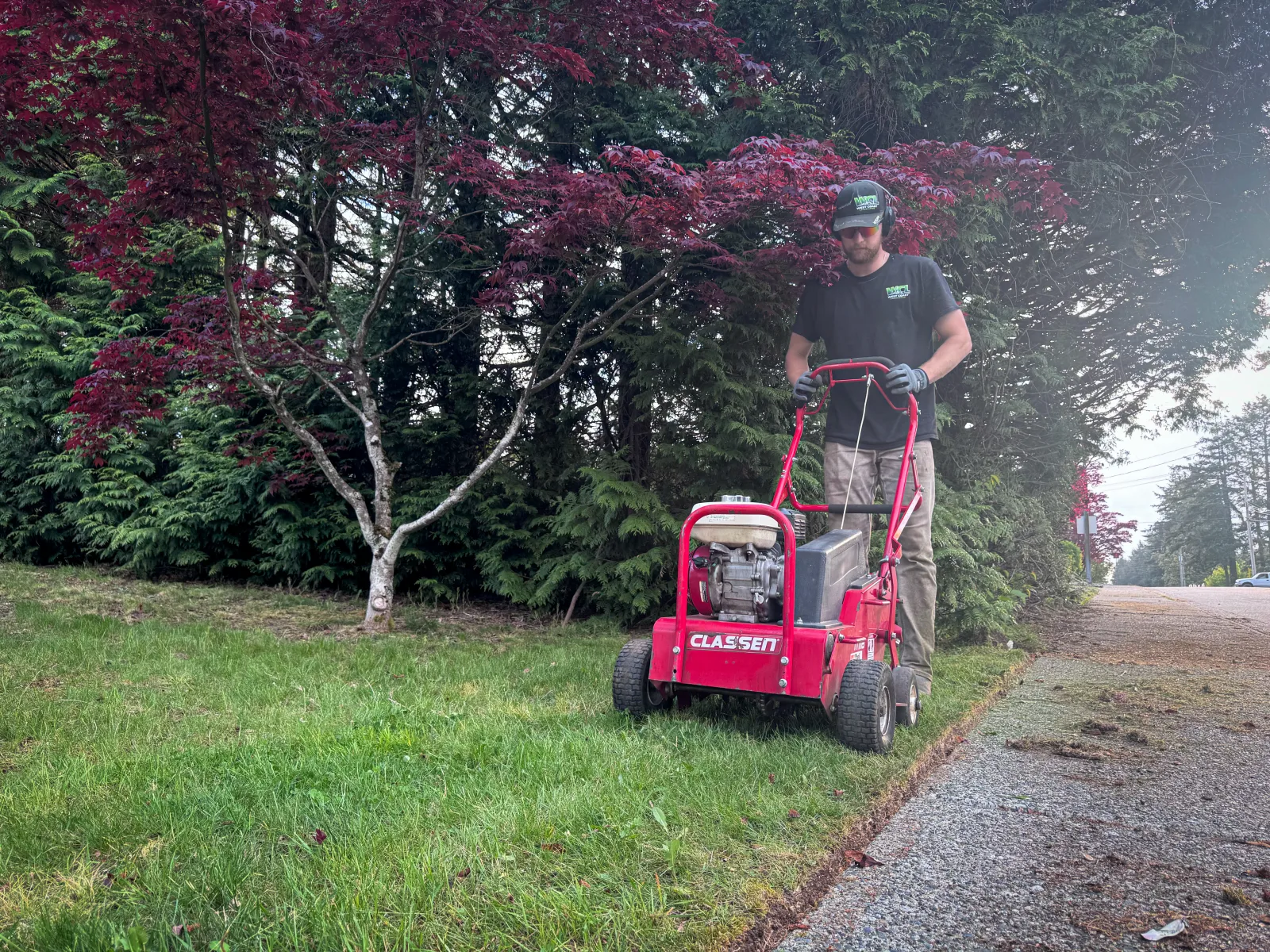
Timing in Nanaimo: April through mid-May is the primary window. The soil is moist enough that plugs extract cleanly without breaking, but not so saturated that you're compacting wet clay with the equipment weight. WCL uses commercial-grade core aerators that pull consistent plugs across the whole lawn — not the patchy results you get from smaller or worn equipment.
Step 5: Follow With Topdressing and Overseeding
Aeration creates the opportunity — topdressing and overseeding take advantage of it. Immediately after aerating, spread a thin layer (6 to 8 mm) of topdressing compost or a sandy loam mix across the lawn surface and rake it lightly so it falls into the aeration holes. This improves soil structure below the surface over the following months as it works its way down.
Then overseed without delay. Grass seed dropped into open aeration channels has direct contact with loosened soil and available moisture — germination rates are dramatically higher than seed applied to an undisturbed surface. For Nanaimo's coastal climate, a perennial ryegrass or ryegrass-fescue blend establishes quickly and handles our wet winters and dry summers well. For more details on how to do this properly, see our guide on lawn top dressing on Vancouver Island.
Step 6: Change Your Habits Going Forward
Aeration fixes the problem; your practices determine whether it comes back. Three adjustments make the biggest difference:
- Water deeply, not frequently. Two or three centimetres of water twice a week pushes roots downward. Light daily misting keeps roots shallow and near the surface, where compaction pressure is highest and drought stress hits hardest.
- Raise your mowing height. Cutting at 7 to 8 cm keeps the canopy thicker, shades the soil surface, and reduces the temperature stress that contributes to surface compaction over a dry summer.
- Aerate on a schedule. On high-clay Nanaimo properties — particularly older neighbourhoods in central Nanaimo and Ladysmith — annual spring aeration is the right interval. On better-draining lots with loam or sandy soil, every two to three years maintains the gains.
The combination of core aeration in spring, topdressing, and overseeding is the most reliable treatment for a struggling Nanaimo lawn. It doesn't require chemicals, doesn't need complicated timing around weather, and the results are typically visible within six to eight weeks — fuller, greener grass that holds up better through the dry summer ahead.