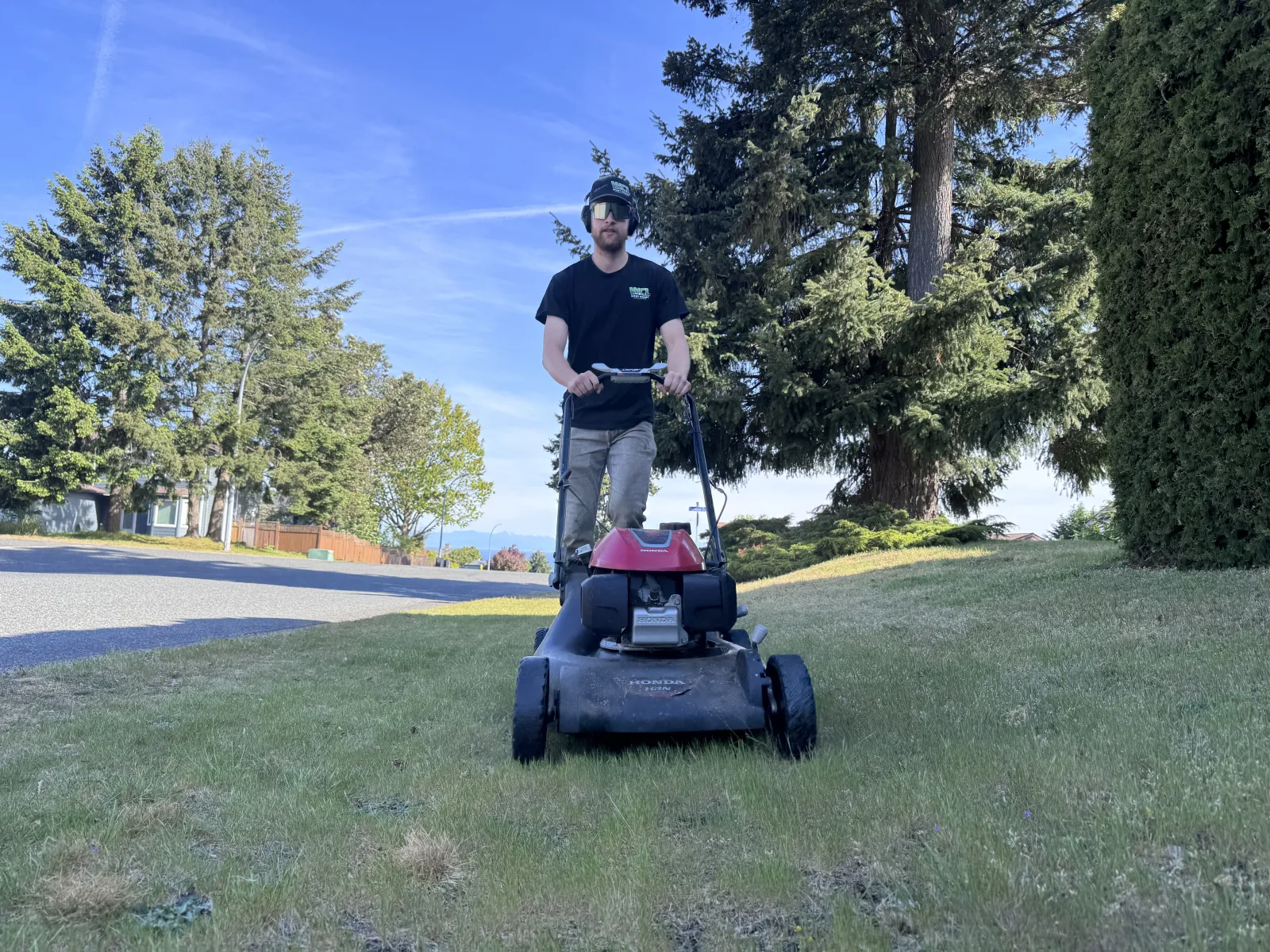
There's a particular moment in late April on Vancouver Island when your lawn starts making demands. After months of soft Pacific rain and cool temperatures, the grass is lush, it's growing fast, and frankly it's looking a bit out of control. The urge to drag out the mower and sort it out is strong.
But the first mow of the season is one of the most consequential cuts you'll make all year. Do it right and you set your lawn up for a healthy, resilient summer. Do it wrong — cut too short, on saturated ground, with a blade that's been sitting in the shed since October — and you're dealing with the fallout through June.
Here on Vancouver Island, where cool-season grasses like perennial ryegrass, fine fescue, and Kentucky bluegrass dominate most Nanaimo and Lantzville lawns, getting the timing and technique right matters. Here's what to think about before that first cut.
Wait for the Ground to Firm Up
The most common mistake on the first mow of the season is simply going too early. Vancouver Island springs are wet — soil stays saturated well into April, and mowing on soft ground compacts soil, creates ruts from mower wheels, and can physically tear up the turf in low spots.
Before you mow, check three things: the grass should be at least 3 inches tall, the soil should feel firm underfoot (not spongy), and there shouldn't be visible puddles or standing water anywhere on the lawn. If you're walking through the grass and leaving footprints that stay pressed down, the ground is still too wet.
In Nanaimo and Lantzville, late April through mid-May is typically the right window. On lower-lying properties, or down around Ladysmith where some neighbourhoods sit on heavier clay soils that drain more slowly, you may need to wait until closer to the end of April or early May before conditions are right.
Push your finger into the soil near the centre of your lawn. If it sinks in more than half an inch without much pressure, it's still too wet to mow safely. Wait another few days and test again.
How High to Cut — The One-Third Rule
The most important principle in lawn mowing is this: never remove more than one-third of the grass blade in a single cut. If your lawn has grown to 4.5 inches over winter, cut to 3 inches. If it's hit 6 inches — which is entirely possible after a mild wet spring — two passes might be needed. Cut to 4 inches first, wait two or three days, then bring it down to your target height.
For cool-season grasses on Vancouver Island, 2.5 to 3.5 inches is the healthy mowing range through most of the season. In late spring and fall, lean toward the higher end. During Vancouver Island's dry summers, keeping grass slightly longer shades the soil, reduces moisture loss, and genuinely helps outcompete weeds and moss for turf coverage.
Cutting too short — what's called scalping — is a reflex many people have after seeing a shaggy lawn. Resist it. Short grass can't photosynthesize as effectively, the root system weakens, and you create exactly the conditions that moss and weeds are waiting for. After a winter of growth, patience pays off more than an aggressive first cut.
Walk the Lawn Before You Start
Ten minutes of prep before the first mow of the season is worth an hour of dealing with problems after. Walk the entire lawn and clear the surface of anything that shouldn't be there.
After winter you'll typically find fallen branches and twigs (they'll chip or damage your blade), rocks that have heaved up through frost and freeze cycles, pine cones, garden stakes that got pushed over, and the inevitable forgotten lawn ornament or dog toy. Any one of these hitting a spinning blade at speed is a problem — both for the mower and for anyone nearby.
Also look for areas where leaves or debris have matted down and smothered the grass. Those patches may need raking before mowing to let the grass stand upright enough to cut cleanly.
Sharp Blades Are Not Optional
A dull mower blade doesn't cut grass — it tears it. You can see the difference in the days after mowing: torn grass tips turn brown and ragged, the lawn looks dull and slightly yellow even right after a fresh cut, and those torn-open tips are exactly where fungal diseases like red thread and fusarium patch get their start.
Both of those diseases are common on Vancouver Island lawns, particularly in the cool wet conditions of late spring. A clean cut means the grass blade seals quickly and stays green. Heading into the season with a freshly sharpened blade isn't just about aesthetics — it's basic lawn health maintenance.
If you can't remember the last time your blade was sharpened, before the first mow of the season is the right time to deal with it. Most hardware stores and small engine shops in Nanaimo can sharpen a lawn mower blade while you wait.
Pattern, Pace, and Technique
Vary your mowing direction from the previous season. If you mowed north-south in the fall, mow east-west or on a diagonal this spring. Repeating the same pattern every cut pushes grass blades in one direction over time and creates visible wear tracks that are hard to reverse.
Mow at a steady, comfortable pace — not rushing. On the first cut after a long winter, the grass is thicker and the mower is working harder than it will be in a weekly rhythm through summer. Let it work at its own speed rather than forcing it through damp, dense growth.
Clippings: Bag Them on the First Pass
For the first mow after a long winter, the clippings are often long enough that leaving them on the lawn creates problems. Long clippings can mat down on the surface in damp conditions, blocking light and holding moisture — exactly the environment that encourages moss and disease.
On the first cut, bag or rake the clippings. Once you're into a weekly mowing rhythm through the summer, leaving short clippings on the lawn (grasscycling) is genuinely beneficial — they break down quickly and return nitrogen to the soil. But that works best when you're only removing an inch or so per cut, not several inches of spring growth all at once.
What to Look For After the First Cut
The first mow of the season gives you the clearest view of what your lawn actually looks like and what it needs. After you've cut, walk it again and take note of:
- Bare or thin patches — prime candidates for overseeding while soil temperatures are still cool and moisture is plentiful
- Moss patches — the ones that survived winter and are now competing with your grass
- Yellowing or pale patches — could indicate pH problems, drainage issues, or early disease
- Uneven growth patterns — fast growth in some areas and slow in others often points to thatch or compaction
- Low spots that held water — worth noting for future top-dressing or levelling work
Late April and May in Nanaimo and Lantzville is your window to address all of these things. Overseeding, lime applications, aeration, and top-dressing all work best in spring when soil moisture is high and temperatures are still moderate. What you notice after the first cut is your season's work list.
"The first mow tells you everything. You cut back the growth and suddenly the whole lawn is laid out in front of you — the bare spots, the moss, the areas that need work. Spring's the time to deal with it."
The goal for that first cut isn't perfection — it's information. Once you've made the cut, you know exactly what you're working with for the rest of the season.