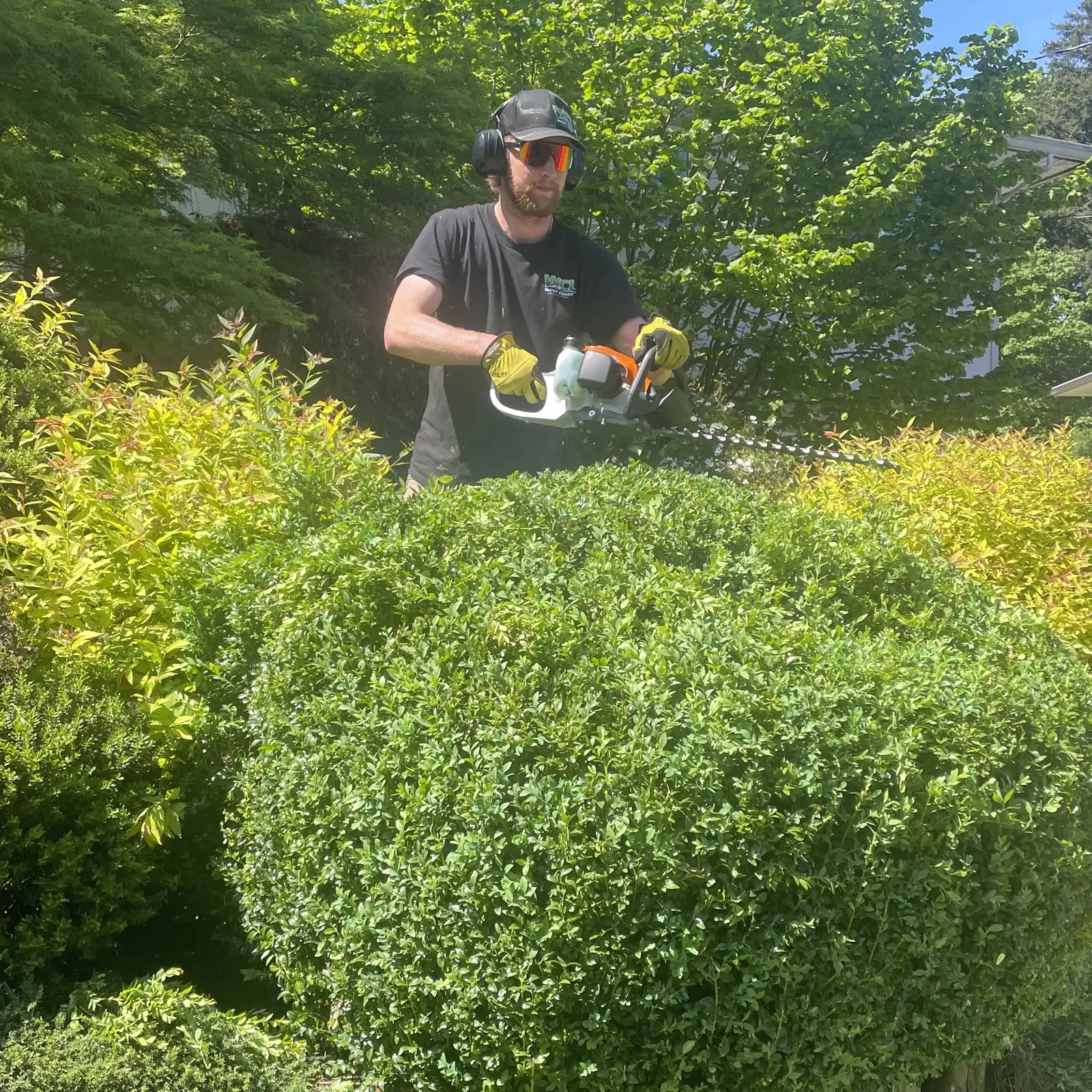
May is when hedge trimming season kicks into gear on Vancouver Island. It's one of those jobs where the difference between a great result and a costly setback comes down to knowing your species, your timing, and your limits. Here are the questions we hear most often from Nanaimo and Lantzville homeowners — answered plainly.
When is the best time to trim hedges on Vancouver Island?
Timing depends on the species, and getting it wrong costs you a season.
Cedar hedges (western red cedar) should be trimmed in late summer — typically late July through early September — after the main flush of new growth has hardened off. Trim too early and you'll shear off tender new growth that's still vulnerable to browning; trim too late and you're going into fall with fresh cuts that won't harden before the wet season. In Lantzville and Nanaimo, the growth flush is usually complete by mid-July, making late July through August the reliable window.
Cherry laurel is more forgiving and can be trimmed in late spring (May–June) and again in late summer. Laurel tolerates a harder cut and responds well to spring shaping as well as a late-season trim to knock back the second flush of growth.
Spring-blooming ornamentals — photinia, lilac, flowering currant — should always be trimmed after they finish flowering, not before. Cut them in early spring and you'll sacrifice that year's blooms. When in doubt, wait for flowers to finish, then trim within a few weeks.
How often should I trim my hedge?
Cedar hedges typically need one trim per year, in late summer. Hedges bordering sidewalks, driveways, or sight lines where width matters may benefit from a light tidy-up trim in spring as well — just to knock back lateral growth without touching the main structure.
Laurel grows considerably faster — often 30–40 cm per year under our mild coastal conditions — and benefits from two cuts: one in early June and one in August or September. Left to grow unchecked for even a single season, laurel can expand dramatically and start pressing against fences, buildings, or neighbouring properties.
The important thing in either case: don't skip years. Annual trimming keeps a hedge dense, even, and manageable. A hedge that gets skipped for two or three years requires significantly more work to restore — and with cedar, you're operating on a much tighter margin of error.
How far back can I cut a cedar hedge?
This is the question with the highest stakes, and the most common source of irreversible damage. Western red cedar will not regrow from bare brown wood. Once you cut past the green living foliage layer into the inner brown stems, that section stays brown permanently — there is no regrowth from old wood, ever.
The rule is absolute: only cut into green growth. For most well-maintained cedars, the green layer is 15–30 cm thick. Annual trimming keeps this layer consistent and gives you a reliable cutting zone year after year.
For a hedge that hasn't been touched in several years, the green layer is thinner relative to the overall size, which means your margin for error shrinks. If your hedge has expanded significantly wider than you want it, restoration requires patience: trim back a few centimetres per year as new green growth fills in the outer surface, gradually reducing width over multiple seasons. Never try to reach your target size in one dramatic cut if bare wood would be exposed.
Can an overgrown cedar hedge be restored?
In most cases, yes — but realistic expectations matter from the start. The top and sides can be reduced gradually, as long as every cut stays in the green layer. Over-tall hedges need their height brought down in stages: a manageable amount each growing season, giving the top time to push out new growth that widens your cutting zone the following year.
A properly managed restoration program — usually spanning two to three growing seasons — can return a neglected Nanaimo or Qualicum Beach property hedge to a tight, uniform shape. Rushing it by trying to reach the target size in one season is precisely how you end up with a hedge that's half brown and permanently disfigured.
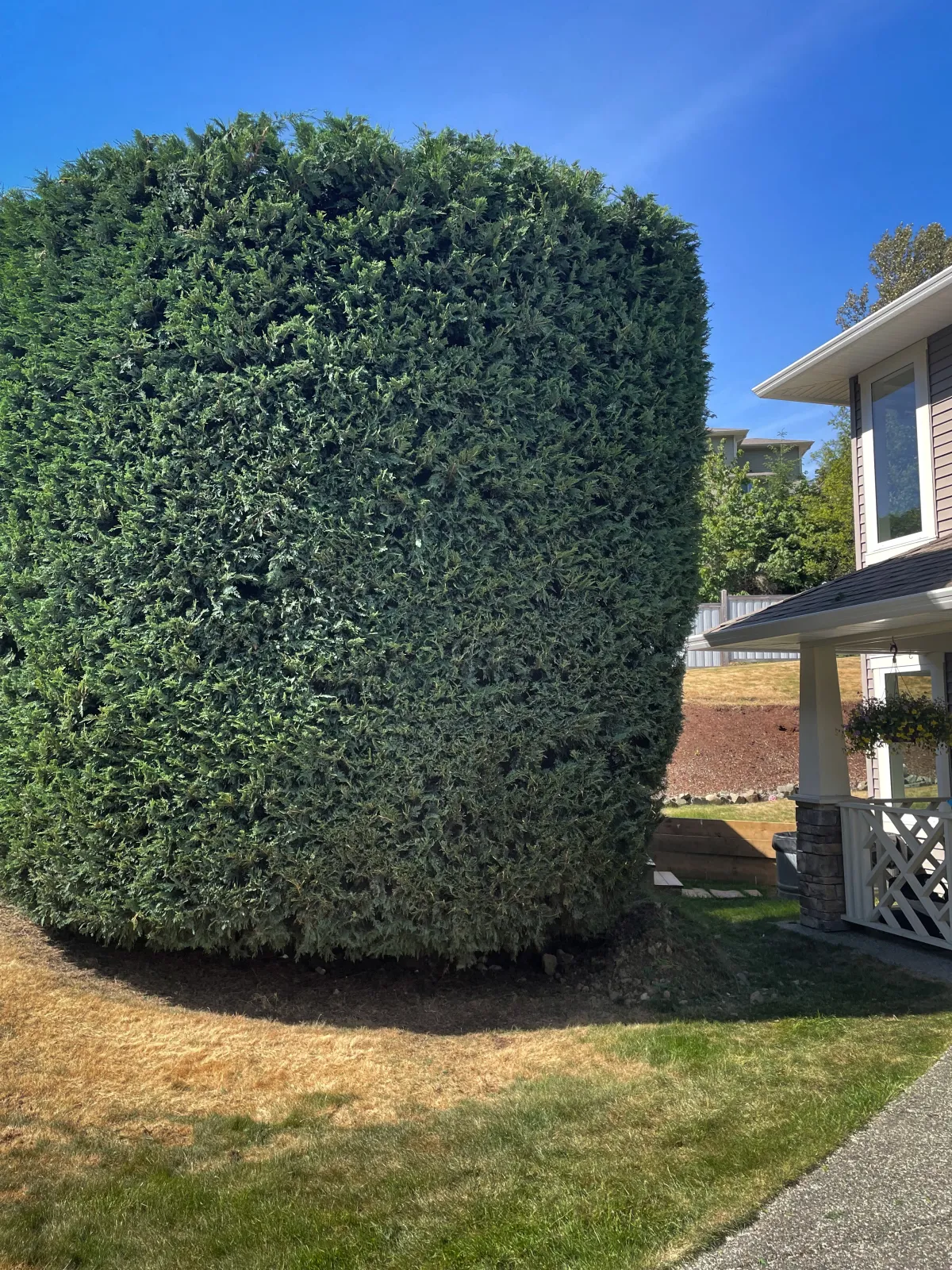
Before any trim, walk the full length of the hedge and look for brown patches, dying sections, or areas where previous cuts have gone into old wood. These zones can't be recovered — they'll need to be worked around carefully or, in severe cases, the affected section replaced. Identifying them before you start saves a lot of frustration mid-job.
What happens to all the trimmings after a professional trim?
This is the part most homeowners don't think about until they're standing in a yard surrounded by a mountain of debris. A single mature cedar hedge job — say 30 metres of hedge at 2.5 to 3 metres tall — can produce 150 to 250 kilograms of trimmings. That's multiple full truck loads of material that needs to be collected and hauled somewhere.
A professional crew arrives with the capacity to handle it: debris gets loaded and transported to a composting facility. When WCL finishes a hedge job at a Nanaimo or Lantzville property, the yard looks cleaner than when we arrived — trimmings, loose foliage, anything that fell on the lawn or garden beds, all gone. That's what a complete job looks like.
For DIY jobs, debris management can take as long as the trimming itself. It also requires a vehicle with real carrying capacity and a plan for where the material goes — not something most homeowners have sorted out before they start. Factor that in when comparing DIY against professional cost.
Should I hire a professional, or can I DIY?
The honest answer: it depends. Small, accessible hedges below shoulder height, well-maintained, and not cedar — a confident homeowner with the right tools can manage those. A quality hedge trimmer, loppers for stray branches, and a tarp for debris collection are the basics.
The risks multiply quickly with height, species, and how long it's been since the last trim. Overconfident cuts into bare cedar wood are the most common mistake we're called in to assess — and most of the time, the answer is "this part can't be fixed." If your hedge is taller than two metres, hasn't been properly trimmed in two or more years, or is cedar, the cost of professional service is almost always less than the cost of a mistake.
There's also the physical reality. Trimming a tall hedge for two hours with a hedge trimmer is hard work. Doing it while also managing your footing, reach, and body mechanics on uneven ground adds a layer of risk that's easy to underestimate until you're mid-job and fatigued.
How do professionals trim tall hedges safely?
WCL uses commercial extended-reach hedge trimmers — specialized equipment that lets us cut accurately from the ground at heights well beyond what a standard hand-held trimmer can reach. That removes most of the up-and-down ladder work that's the most common source of injury on hedge jobs, and the reduced fatigue means more consistent results across a long run of hedge than you'd get from someone working off a ladder repeatedly.
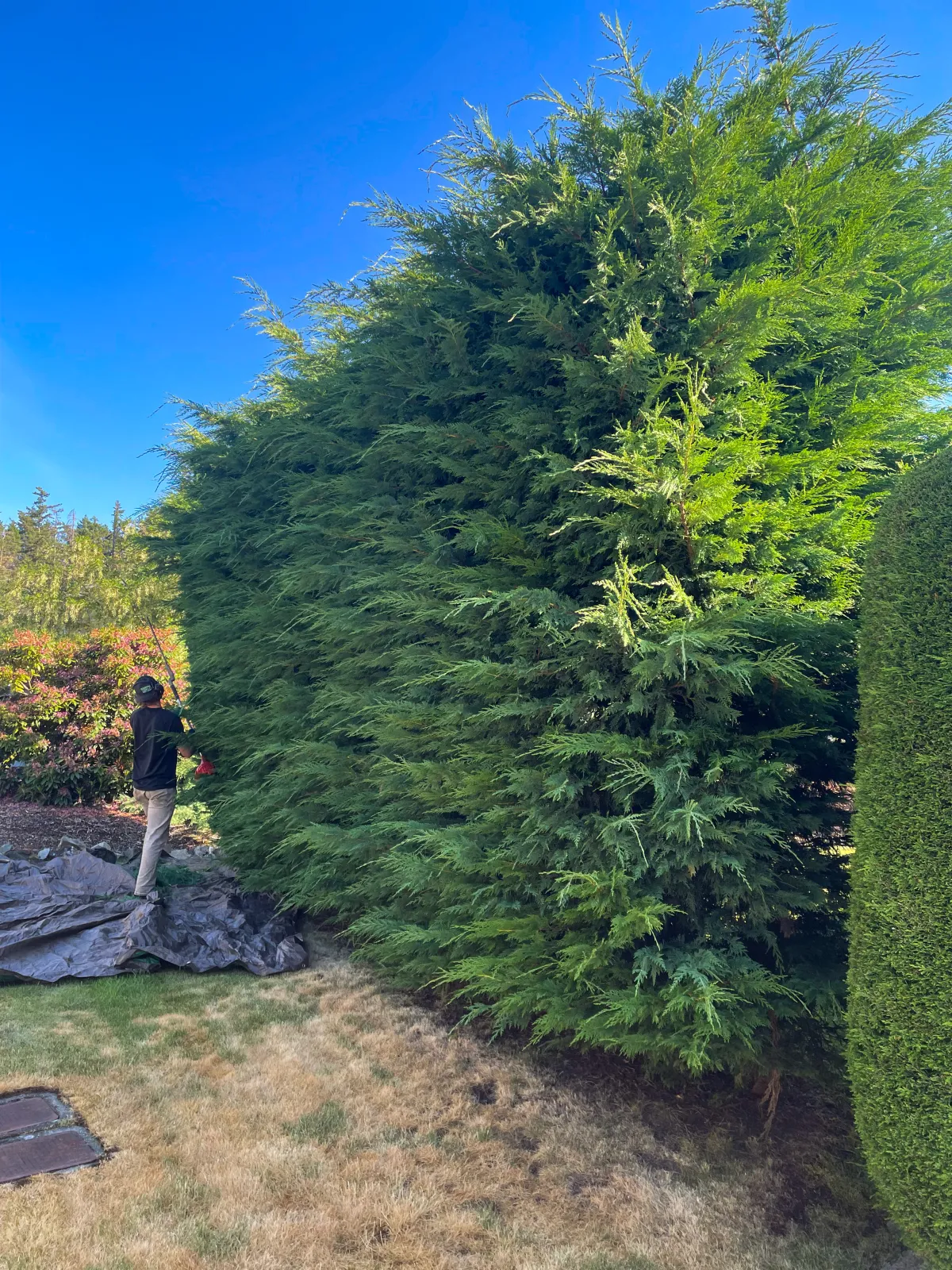
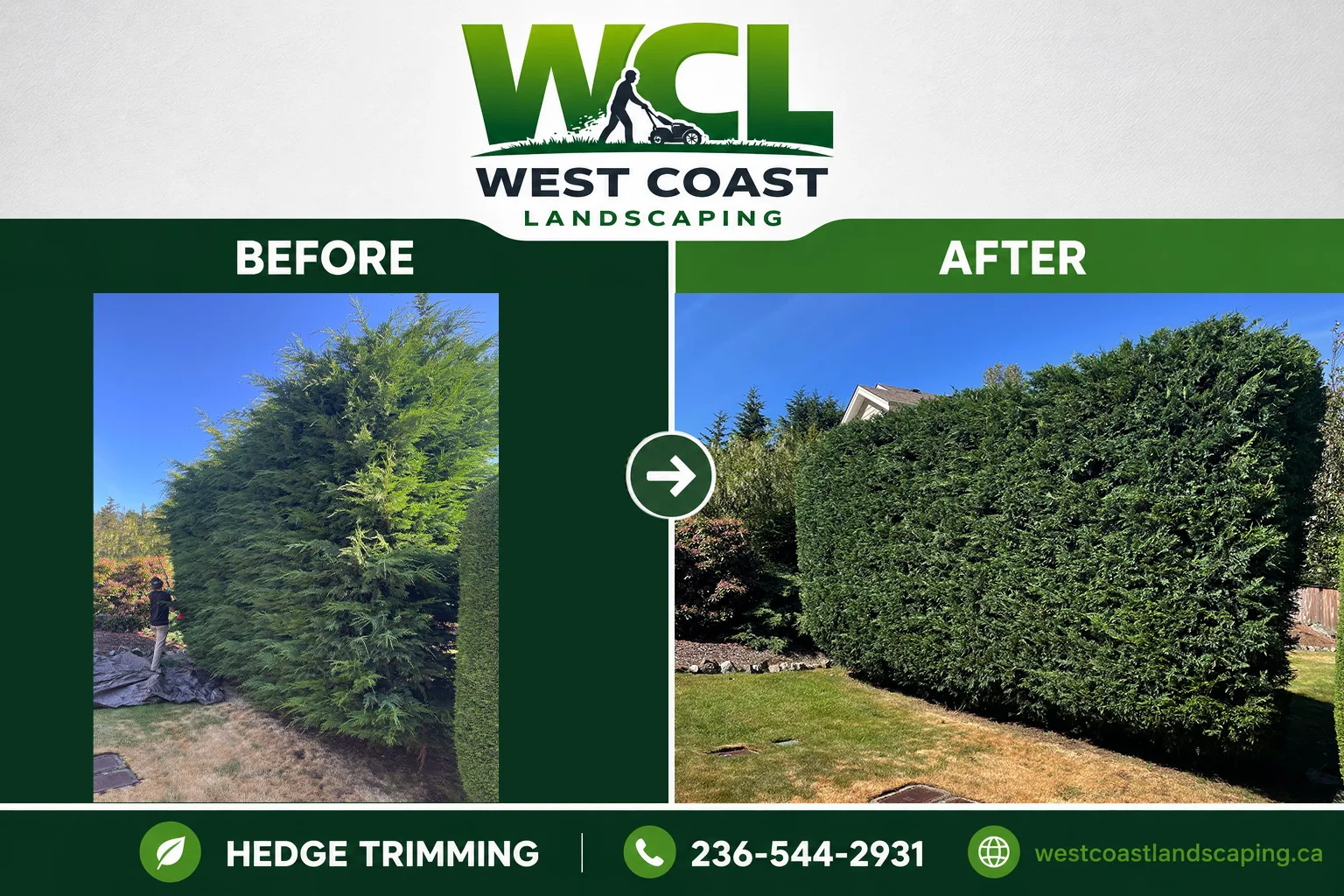
Extended-reach tools also allow better angle control. A properly trimmed hedge should be slightly wider at the base than at the top — a bevel profile that ensures sunlight reaches the lower foliage and keeps the hedge dense right down to the ground. Maintaining consistent angle across a long hedge is difficult from a ladder; from the ground with proper equipment, it's precise.
On larger jobs, the hockey teammates who work alongside Matthew show up in matching WCL uniforms and are trained on the equipment — not a pickup crew assembled for the day. Big properties that need a full hedge done efficiently benefit from the extra hands and consistent approach across the whole job.