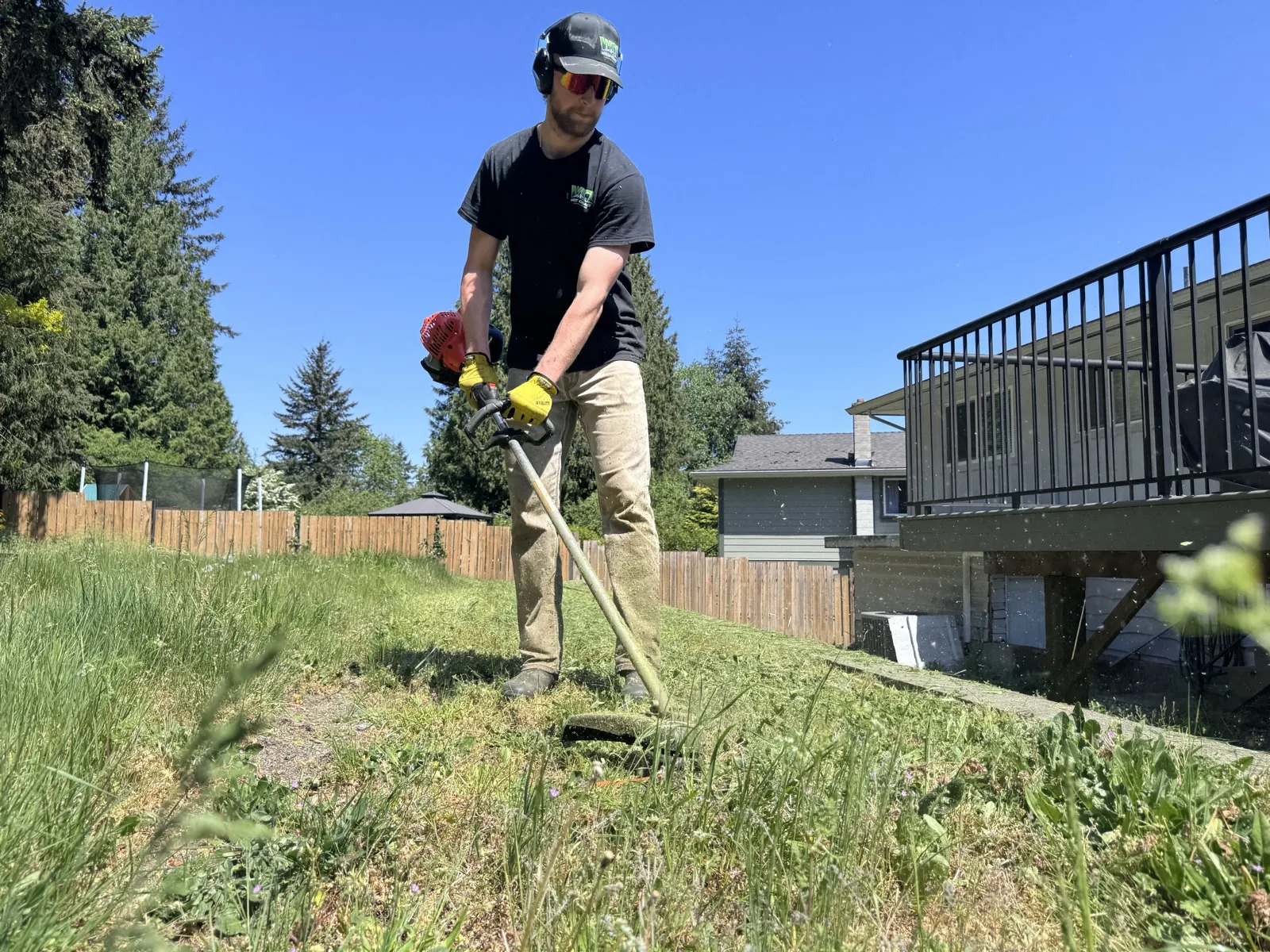
Late April is prime time for weeds here on Vancouver Island. The soil has warmed up, moisture is still plentiful from spring rains, and the weeds — dandelions, white clover, creeping buttercup, broadleaf plantain — are growing fast while your lawn grass is still finding its footing. If you're going to get ahead of them, now is the window.
The challenge for Nanaimo and Lantzville homeowners is that weed control is a topic that often comes with a misleading answer: just spray it. In reality, spray-based herbicide applications require a licensed pesticide applicator in BC. The spray step — iron sulphate for moss, selective herbicides for broadleaf weeds — is something you either handle yourself or hire a licensed applicator for. At West Coast Landscaping, we don't apply chemical sprays. What we do handle is everything else: the physical work that makes chemical treatment unnecessary over time, or that supports it when you've done the treatment yourself.
Here's how to actually get a handle on spring weeds in your lawn — with or without sprays.
Know What You're Dealing With
The weeds that show up most in Nanaimo and Lantzville lawns share one thing in common: they thrive in conditions where grass is struggling. Thin turf, compacted soil, low pH, poor drainage — weeds are opportunists. Understanding what's growing in your lawn tells you something about what the lawn needs.
Dandelions
The classic. Deep taproot, reseeds prolifically, impossible to fully remove by hand unless you get the whole root. Dandelions tend to colonize thin spots and edges. A healthy, dense lawn is your best long-term defence — they have a much harder time establishing where the grass is thick.
White Clover
Clover spreads by runners and takes hold in low-nitrogen soil. Interestingly, it fixes atmospheric nitrogen, so its presence in your lawn can be a sign you're under-fertilizing. Improve your fertilization schedule and clover tends to retreat as grass out-competes it.
Creeping Buttercup
This one's particularly stubborn on Vancouver Island — we have the wet conditions it loves. It spreads by runners and establishes fast in areas with poor drainage or compacted soil. Improving drainage through aeration and overseeding thins it out over time, but established patches often need physical removal.
Broadleaf Plantain
Flat rosettes that sit low to the ground, impossible to mow off. Thrives in compacted, high-traffic areas. If you're seeing lots of plantain, your soil needs aeration. Once the soil is loosened, grass can establish and crowd it out.
Annual Bluegrass (Poa annua)
Light green, clumping grass that looks wrong in a dark ryegrass or fescue lawn. It dies out in summer heat, leaving bare patches. It's opportunistic — seeds constantly, and gets in when there's a thin spot to exploit.
The Real Long-Term Answer: A Dense, Healthy Lawn
Before we get into specific tactics, it's worth saying this clearly: a thick, well-maintained lawn is the most effective weed control there is. Weeds need space and light to germinate. Dense turf denies them both.
This is why the spring work matters so much. If you aerated, dethatched, overseeded, and fertilized in March and April, you're already putting the lawn in a stronger position to crowd out weeds on its own. That work doesn't pay off immediately — it builds over a season — but it's far more effective than fighting individual weeds in a thin lawn year after year.
A lawn that's fed, aerated, and densely seeded gives weeds nowhere to get started. Treat the lawn, not just the weeds.
Mowing Height: Don't Scalp It
One of the easiest things homeowners do wrong is mowing too short. Scalped grass is stressed grass — it depletes its energy reserves trying to recover, roots stay shallow, and it's far more vulnerable to weed invasion and drought stress heading into summer.
Here on Vancouver Island, we're mostly dealing with cool-season grasses: perennial ryegrass, creeping red fescue, Kentucky bluegrass. These do best at 6–8 centimetres (about 2.5–3 inches). At that height, the canopy shades the soil surface and dramatically reduces weed seed germination. It also keeps the root system healthier and more drought-resistant as summer approaches.
A good rule of thumb: never remove more than one-third of the blade length in a single mow. If the lawn got away from you over a rainy week, take it down gradually over two or three cuts rather than scalping it back in one go.
Physical Removal: Worth It for Some Weeds, Not Others
Hand-pulling weeds works well for dandelions if you get the whole taproot — a weeding tool or fork helps here. It's labour-intensive but genuinely effective for isolated plants in otherwise healthy turf.
For spreading weeds like creeping buttercup, physical removal is less satisfying. You can pull runners, but unless you're removing root sections too, they regrow. For heavy infestations in Parksville properties we've seen, the practical answer is removing the worst patches, aerating the soil, and overseeding to crowd them out over a season rather than trying to pick every runner by hand.
The realistic approach: hand-pull what's practical — dandelions before they seed, isolated clover patches — and focus energy on improving the lawn so future generations of weeds have less to work with.
Granular Lime: The pH Factor
Coastal BC soils tend to run acidic, and low-pH soil creates conditions where moss and some weeds thrive while grass struggles. A soil test will tell you where you stand, but most Nanaimo and Lantzville lawns benefit from lime application every year or two.
Granular lime (dolomitic lime or calcitic lime) is safe, not a regulated spray, and can be applied by hand spreader. It raises soil pH gradually, improving the conditions for grass to thrive. It won't kill existing weeds, but it shifts the environment in grass's favour over time.
We apply granular lime as part of our lawn maintenance service. It's the kind of detail that quietly makes a big difference over a season — the lawn just gets easier to manage.
A Note on Chemical Sprays
Some weeds genuinely respond best to a targeted herbicide application. If you're dealing with a serious creeping buttercup infestation or a lawn that's more weed than grass, a selective broadleaf herbicide can reset the situation faster than physical methods alone.
In BC, applying registered pesticides requires a valid applicator certificate, or you can use consumer-labelled products on your own property following label directions. West Coast Landscaping doesn't apply herbicide sprays — that part of the job is yours or a licensed applicator's. What we handle is everything around it: the aeration, overseeding, granular amendments, and ongoing maintenance that makes the spray step less necessary over time, and more effective if you do it.
"You handle the spray if you need it. We handle everything else."
Mulching Garden Beds: Stopping Weeds Before They Start
Most weed problems in lawns start at the edges — weeds from unmulched garden beds migrate into turf. A 5–8 cm layer of mulch in your beds blocks weed seed germination and keeps existing beds clean, which keeps pressure off the lawn edges too.
Late April and May is the ideal window for mulching. The soil has warmed enough that you're not trapping cold in, and you're getting ahead of the summer weed flush. We handle garden bed care as part of our Complete Exterior Care plan — weeding, mulching, and edging all bundled in.
Putting It Together for Your Nanaimo Lawn
The weed control approach that actually works over time isn't one thing — it's a combination:
- Aerate and overseed to build lawn density (done in spring or fall)
- Fertilize on schedule so grass out-competes low-nitrogen weeds like clover
- Mow at the right height to shade weed seeds out
- Apply granular lime if soil pH is low
- Hand-pull isolated weeds before they go to seed
- Mulch garden beds to reduce edge pressure
- Use a selective herbicide if you need a reset — following label directions or using a licensed applicator
It's less exciting than a single spray-and-done solution, but it builds a lawn that genuinely gets easier to maintain each year. If you're in Nanaimo, Lantzville, or Parksville and your lawn is losing ground to weeds, it's usually a sign the lawn needs attention — not just the weeds.