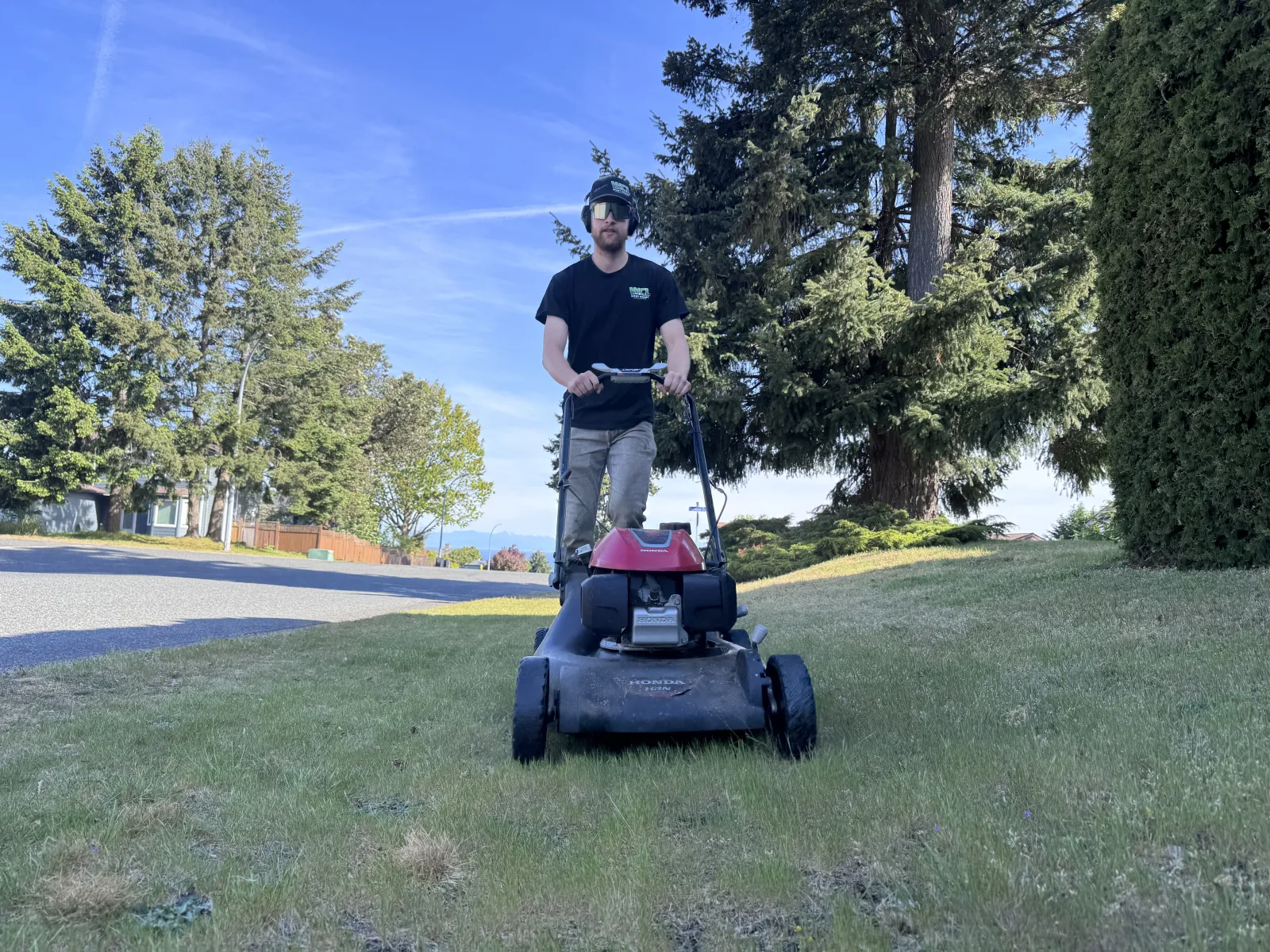
There's a moment — you've probably noticed it on a neighbour's property — where a lawn looks instantly sharper. The grass isn't necessarily longer or thicker than usual. But there's something crisp about it, something finished. Most of the time, that detail is the edges.
Sharp lawn edges are the difference between a maintained yard and a well-maintained yard. And here in Nanaimo and Lantzville, where our wet winters let grass rhizomes creep steadily outward for six months without being checked, the first edging of the season in late April is one of the highest-impact things you can do to a property. It's unglamorous, but it works.
What Edging Actually Does — and Why It's Not the Same as Trimming
This distinction matters before you pick up any tool. A string trimmer cuts grass horizontally, knocking down whatever sticks up above the edge of a path or bed. It tidies. But it doesn't create a defined vertical face between the lawn and the surface it meets — and that vertical face is the whole point of edging.
True edging cuts straight down through the sod layer, typically 5–7 cm deep, creating a clean boundary between the lawn and whatever it borders: driveway, patio, path, or garden bed. That cut does two things simultaneously. First, it looks sharp — you can read it from the street. Second, it physically interrupts the lateral growth of grass roots and rhizomes. Without a regular cut to stop them, turf will slowly colonize your garden beds and push over your driveway edge.
Choosing Your Edging Tool
Several tools can do this job, each with a different use case.
Half-Moon Edger
A manual tool with a flat, semicircular blade on a long handle. Push it straight down along the edge of a bed or path and it cuts cleanly through sod. Best for curved bed borders and occasional maintenance. Slow, but precise — and good for spots where a power tool would be clumsy.
Rotary Edger
A manual wheeled tool that rolls along a driveway or path edge with a small blade cutting at the border. Good for straight runs. Low effort once you find the groove, though it won't perform well on a first pass after a winter of growth.
Power Edger
An electric or gas-powered tool with a spinning vertical blade. This is what we use at West Coast Landscaping — it makes short work of long driveway runs and produces a consistent, clean cut regardless of how far the grass has crept. For larger properties or for anyone doing weekly lawn maintenance professionally, a power edger is the practical choice. If you'd rather skip the gas entirely, our battery-powered zero-emission lawn care uses electric edgers and trimmers exclusively.
String Trimmer Held Vertically
Works as a finishing tool — useful for touching up ragged sections after the main edge is cut. Not ideal for primary edging because it's hard to control cut depth consistently, and it tends to leave a rougher face than a blade tool.
A sharp half-moon edger outperforms a dull power edger every time. If you're using manual tools, sharpen the blade before the season starts. File the lower bevel edge on the blade with a metal file — five minutes of prep saves twenty minutes of effort.
Step-by-Step: How to Edge Your Lawn
Step 1: Clear the Edge Zone
Before cutting anything, remove leaves, old mulch, or loose soil sitting along the edge line. It sounds trivial, but debris hides exactly where the lawn ends and the hard surface begins. Working on a clear edge lets you place the blade precisely on the first pass.
Step 2: Edge Along Hard Surfaces First
Driveways, paths, and patios get done first because they require the straightest, most consistent cut. Position the edger blade exactly at the point where turf meets hard surface. Work in smooth, even passes — no jerking, no rushing. On the first pass of the season, you may need to make two cuts in the same spot to work through compacted grass and sod that's crept over the edge during winter.
Target depth: 5–7 cm. Shallower than that and you're not cutting through the root zone; deeper and you start creating a channel that can become a trip hazard on path edges and a water trap next to driveways.
Step 3: Redefine Garden Bed Borders
Curved bed edges need a more careful approach. A half-moon edger or flat spade gives you more control on curves than any wheeled tool. Cut straight down along the border of the bed, keeping the blade vertical — or angled very slightly outward so the face of cut soil is visible from the bed side.
If the grass has grown substantially into the bed over winter, you may need to do this in two steps: first cut the new edge line, then pry out and remove the strip of sod between your old line and the new one. It's extra work on the first pass, but every subsequent maintenance pass takes a fraction of the time.
Step 4: Remove All Cut Material
This is the step that most people underestimate. Edging generates a surprising amount of debris — severed sod, soil cores, clumps of grass — and all of it needs to come off the lawn surface and out of the beds.
Left on the turf, cut grass and soil blocks sunlight from the lawn below and causes dead patches. Left in garden beds, it composts unevenly and can bring weed seeds with it. Rake or sweep everything into a pile, then bag or wheelbarrow it to your compost. At WCL, the cleanup is half the job — a properly edged property with debris left behind just looks like a construction site.
Step 5: Final Inspection and Tidy-Up
Walk the full perimeter of the edged area and look for spots you missed, sections where the cut is uneven, or corners that need attention. A string trimmer held vertically can clean up these sections efficiently. Look especially at inside corners near fence posts and around trees or garden features where the main edger couldn't reach.
Step 6: Establish a Maintenance Schedule
The most important thing about lawn edging is that it becomes much easier once you've done it once. That first pass of the season — especially in Qualicum Beach and older Nanaimo neighbourhoods where edges have been neglected — can take significant time. Every pass after that is maintenance, not restoration, and it goes quickly.
During Vancouver Island's active growing season (roughly April through October), edges need attention every three to four weeks. If you're on a regular mowing schedule, edging should be built into that same visit — it adds time but the visual return is immediate.
When the Edge Has Been Lost Completely
Some properties — particularly those where lawn care has been sporadic — have no defined edge left at all. The lawn has colonized the beds, the driveway border is a ragged blur, and there's no line to maintain. This takes more work to fix, but it's not a write-off.
Use a flat spade or half-moon edger to cut a new edge line where you want it. Then physically remove the strip of encroaching turf — cut it into sections and peel it back. This sod can go directly into the compost or green waste. Once the new edge is clean, maintain it at the three-to-four-week interval and it will stay sharp indefinitely.
The first proper edging on a neglected property is genuinely a transformation. We've done jobs in Nanaimo where the edge work alone — before any mowing — made the property look like a different address.